What is real estate crowdfunding and how does it work?
For a long time, investing in property was reserved for those who could buy an entire home or commercial unit, with all the money and paperwork that involves. Real estate crowdfunding offers another way of doing it.
IN THIS ARTICLE 6 sections
There is probably a fenced-off plot or a building wrapped in green netting somewhere near you. In two years' time there will be flats there, and whoever put up the money to build them may have earned a lot along the way. What hardly anyone knows is that today that someone can be anyone, with a few hundred euros and a mobile phone.
Until recently it made no difference whether you knew, because there was no way in. Getting into bricks and mortar meant scraping together a sixty-thousand-euro deposit, signing a twenty-year mortgage and ending up taking calls from a tenant whose boiler had broken down. The part of the business where the real money can be made, financing the construction, was reserved for those who moved millions.
That is what has changed, and it is called real estate crowdfunding. In three minutes you will understand exactly how it works.
Why this exists
A developer may have ten good projects on the table and money for only two.
The developer is the company that buys the land, builds the homes and sells them. For a five-million-euro development the bank lends most of the money, but it requires the developer to put in a sizeable chunk of its own, and that chunk is its bottleneck. After 2008 the banks tightened their criteria even further, and many perfectly viable developments stalled because that part could not be raised. At the same time, the internet was proving that a million euros could be raised from thousands of strangers to fund almost anything. Bringing the two ideas together was only a matter of time.
That missing part is exactly where you come in. And this is not lawless territory: the platforms operating in Spain are authorised and supervised by the CNMV under a European regulation, with a licence that also allows them to offer you projects in France, Italy or Portugal.
How it works, step by step
Five things happen between the developer knocking on the door and the money coming back to your account.
-
01
The screening. The developer takes its project to a crowdfunding platform, an authorised company that finances real estate projects by pooling money from many small investors through its website. The platform checks who the developer is, what it has built before, what the land is worth, what the construction costs, what the flats will sell for and whether the building permit has been granted. Of everything that comes in, it publishes only a part.
-
02
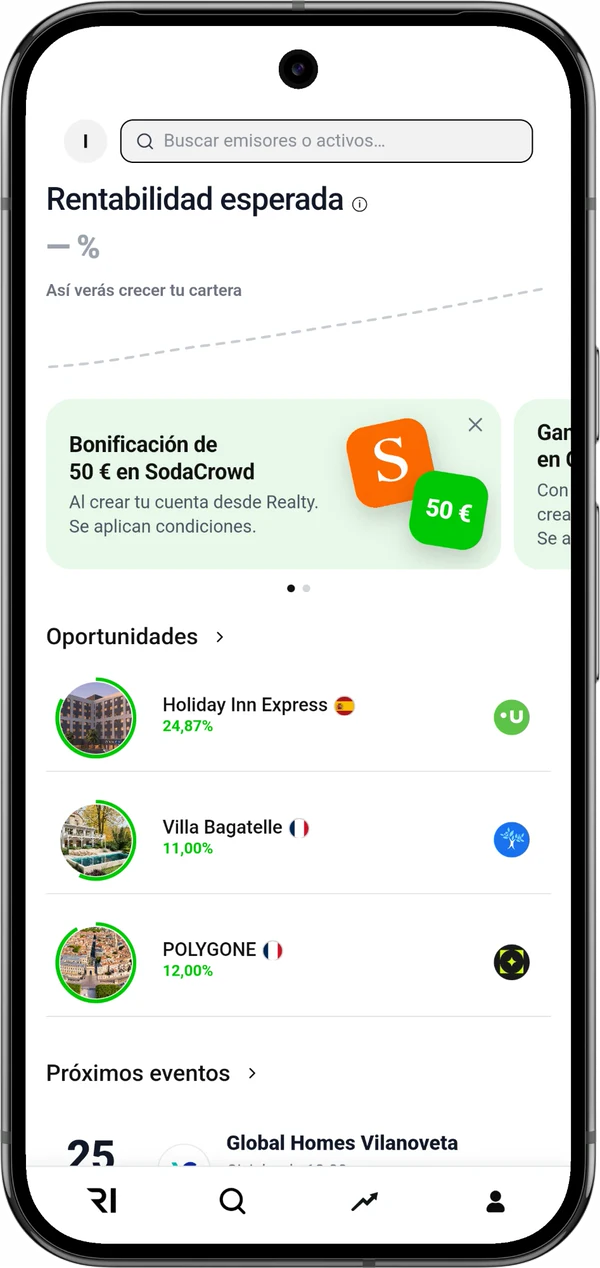
The listing. A project that passes the screening is published on the platform's website with the amount being raised, the expected term, the estimated return and the documents for you to review yourself. That listing is all the information you get: nobody is going to call you to give you advice.
-
03
The funding round. Fundraising opens and each investor puts in whatever they want, starting from the platform's minimum, which is usually €250 or €500 per project. When the total reaches the target, the round closes and the money goes to the project. If the target is not reached, the money goes back to your account in full.
-
04
The wait. Your money stays locked in while the building goes up, usually for between one and three years. During that time there is nothing for you to do, and you cannot take it out whenever you feel like it either.
-
05
The repayment. At the end, your capital comes back with its return. How much, and where it comes from, depends on the way you invested, which is what comes next.
Many rounds fill up quickly and there is no waiting list, so the moment you find out determines whether or not you can take part.
One general idea worth bearing in mind throughout: since each development depends on a specific developer and a specific city, putting all your money into a single project exposes your result to whatever happens to that project. Diversification is one of the basic principles of this type of investment.
KEEP READING · 03 How many projects to invest in ›The two ways in
They look alike on screen and are nothing alike in your pocket.
You act like a small bank: you lend at an interest rate set in advance and for a fixed term. If all goes well you get your money back plus interest, and not a euro more even if the developer makes three times as much. In exchange, you get paid before the developer does, and there is usually collateral behind the loan, such as a mortgage over the land, which helps but does not ensure that you get your money back.
You buy a stake in the company developing the project and take your percentage of the profit from the sales. If it goes better than expected you earn more, and if it goes worse you earn less or lose money. Longer terms and a result that varies more in both directions.
Neither is better than the other: in one the return is capped in advance and in the other it is not, in exchange for a result that is more variable in both directions.
What protects you and what doesn't
This is something you should be told before you invest, not after.
The law requires every project to publish a standard key investment information sheet with the key data, makes you take a test before letting you invest if you have no experience, and gives you four days to back out without giving any reason. Nor is your uninvested balance held by the platform: it sits with an independent payment institution.
What you do not have is a safety net. This is not a deposit and it is not covered by any guarantee fund. The return you see published is the developer's estimate, not a promise. You can lose your capital and, above all, you can be paid later than expected, which is what happens most often.
With this on the table, you can now read any project knowing what you are dealing with.
Before you open your first listing
There are three figures that change the outcome far more than they appear to: the LTV, the building permit and pre-sales, and the fees. Each has its own article because each one, on its own, can turn a good project into a mediocre one.